The intrinsic variability of solar and wind energy, compounded by their rapid expansion, has intensified power curtailment challenges. Although spatiotemporal complementarity between these resources is widely recognized as a pathway to enhance renewable integration and reduce balancing requirements, existing assessments are largely based on hypothetical deployments. Consequently, how solar–wind complementarity manifests under real-world infrastructure and shapes system-level integration outcomes remains unclear. Here we develop a unified national inventory to enable a data-driven assessment of solar–wind complementarity. The inventory covers 319,972 solar photovoltaic facilities and 91,609 wind turbines in 2022, identified from sub-metre satellite imagery using a deep-learning-based framework. Using this dataset, we show that solar–wind complementarity substantially reduces generation variability, with effectiveness increasing as the geographic scope of pairing expands. At the system level, nationwide inter-provincial coordination raises effective renewable penetration by 99.88?TWh in an 80% dispatchable-flexibility system, corresponding to 9.1% of total solar and wind generation, or approximately 120?h of national average load. These findings demonstrate that energy complementarity is a scalable, system-wide mechanism for advancing solar and wind penetration, offering broadly applicable insights into the role of inter-regional coordination in enhancing renewable integration in large power systems.
人工智能Artificial Intelligence
Efficient robot navigation inspired by honeybee learning flights
受蜜蜂学习飞行启发的高效机器人导航
▲ 作者:Dequan Ou, Jesse J. Hagenaars, Maciej R. Jankowski, Michiel V. M. Firlefyn, Christophe De Wagter, Florian T. Muijres, et al.
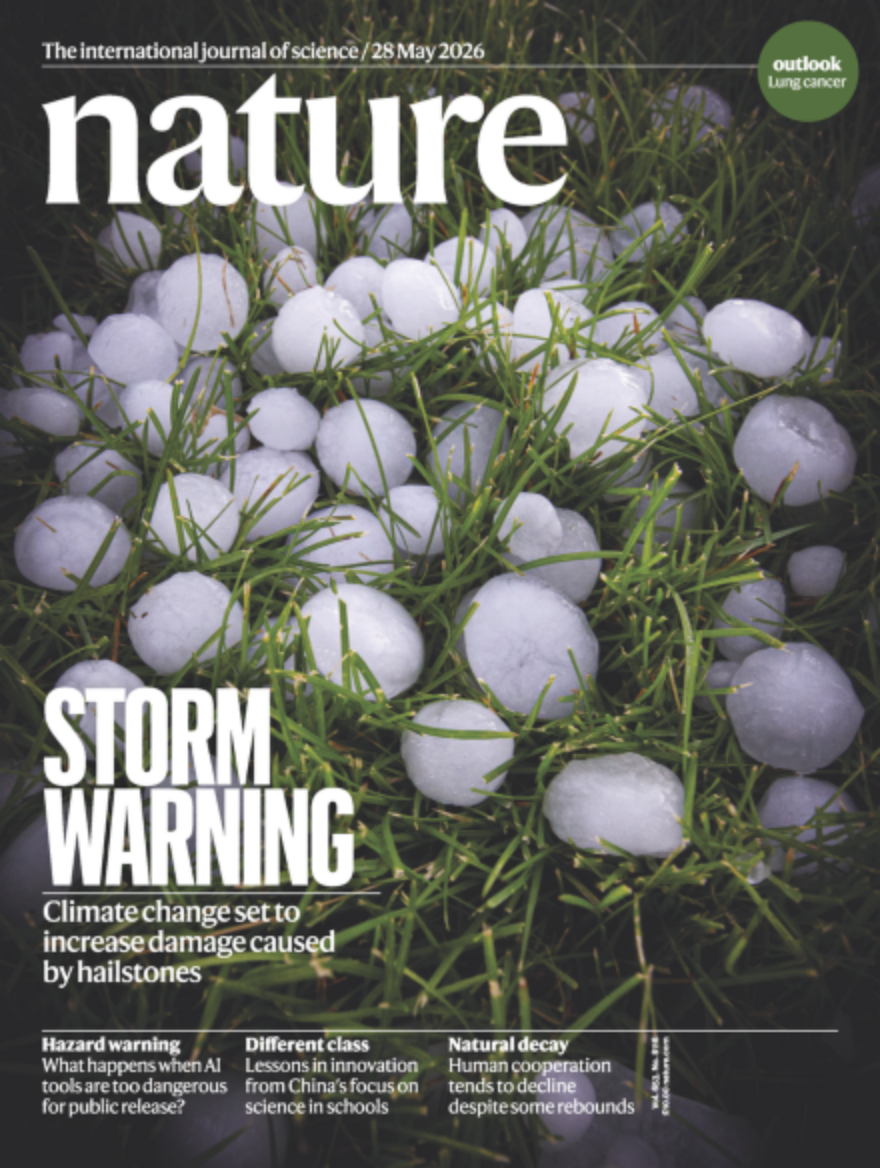
Anthropogenic climate change (ACC) is expected to modify severe convective storms and their associated hazards, including hailstorms, a primary driver of weather-related economic losses. Despite some research on the response of hailstorms to ACC, most studies have focused on regional-scale changes, whereas global-scale assessments of hailstone size remain scarce. Here we show a 36.5–42.1% increase in global hailstorm-induced damage potential by the late twenty-first century, with the magnitude determined by the emission scenario. Our results arise from hailstone trajectory simulations conducted under historical and future scenarios, driven by EC-Earth3 ensemble outputs that are cross-validated through multimodel comparisons. Globally, increased low-level temperature and specific humidity drive a shift towards larger hailstones, with the frequency of ≥30-mm-diameter hailstones rising by 37.9–51.8% and <30-mm-diameter hailstones declining by 4.2–12.3%. Regionally, the mid-high latitudes predominantly exhibit increased hail damage potential owing to strong warming and weak moistening, amplifying instability sufficiently to counteract enhanced drag and melting effects. Conversely, tropical and monsoonal regions experience reduced hail damage potential owing to weak warming, strong moistening and limited hail growth depth. Our findings highlight the non-uniform impacts of ACC on global hailstorm damage, providing critical insights for future disaster prevention and mitigation strategies.
Navigation is a crucial capability for both animals and robots. Although tiny flying insects can robustly navigate over long distances, state-of-the-art robot navigation methods are computationally expensive and therefore restricted to large robots. Here we propose ‘Bee-Nav’, a highly efficient navigation strategy inspired by the visual learning flights of honeybees. In equivalent robotic learning flights, a tiny neural network is trained to map omnidirectional images to a home vector based on path integration. After learning, the robot can fly far away from home, come straight back using path integration and cancel integration drift using the visual homing network. Simulations showed that, for realistic path integration accuracies, the neural network requires training on only approximately 0.25–10.00% of the total flight area. In real-world indoor and outdoor experiments, a small drone successfully returned to within 0.5?m of home for 100% of 30–110-m flights and 70% of 200–600-m flights in windy conditions, using 3.4-kB and 42-kB neural networks, respectively. The proposed navigation strategy will be vital for resource-constrained robots that perform tasks while travelling from and to a home location. Furthermore, it provides new perspectives on the neuroethology of insect navigation, from how visual learning shapes homing trajectories to the nature of cognitive maps.
地球科学Earth Science
Divergent urban storm response to convective, frontal and tropical systems
Recent discoveries of faint active galactic nuclei (AGN) at the redshift frontier have revealed a plethora of broad Hα emitters with optically red continua, named little red dots (LRDs), which comprise 15–30% of the high-redshift broad-line AGN population. Owing to their peculiar properties, modelling LRDs with standard AGN scenarios has proven challenging. In particular, the validity of single-epoch virial mass estimates in determining the black-hole masses of LRDs has been called into question, with some models claiming that masses might be overestimated by up to two orders of magnitude. Here we report a direct, dynamical black-hole mass measurement in a strongly lensed LRD at a redshift of 7.04. The combination of lensing with deep spectroscopic data reveals a rotation curve that is inconsistent with a nuclear star cluster, yet can be well explained by Keplerian rotation around a point mass of 50?million solar masses, consistent with virial black-hole mass estimates. The Keplerian rotation leaves little room for any stellar component in a host galaxy, as we conservatively infer MBH/M? > 2 (where MBH is the black-hole mass and M? is the stellar mass). Such a ‘naked’ black hole, together with its near-pristine environment, indicates that this LRD is a massive black-hole seed caught in its earliest accretion phase.
物理学Physics
Experimental randomness amplification
实验随机性放大
▲ 作者:Anatoly Kulikov, Simon Storz, Josua D. Sch?r, Martin Sandfuchs, Ramona Wolf, Florence Berterottière, et al.
Urbanization modifies precipitation, yet previous studies have reported inconsistent results, with some cities experiencing rainfall enhancement and others showing suppression. To reconcile these discrepancies, we examine how urban impacts vary across storm types using an event-based analysis. With three-dimensional radar reflectivity data (1995–2017), we identify more than 40,000 warm-season storms across four Texas cities (Dallas, Austin, San Antonio and Houston). Here we show that classifying storms into five types reveals distinct urban influences linked to storm scales and dynamics. Local-scale single-cell and isolated storms, driven by atmospheric instability, increase in frequency (7–31%), particularly at night. Synoptic-scale frontal storms show unchanged occurrence but contrasting intensity responses: cold fronts weaken over cities by 16–28%, probably because of thermal and roughness effects, whereas warm fronts exhibit enhanced reflectivity. Tropical systems show no consistent change in frequency or intensity but exhibit a shift of high-reflectivity grid cells towards lower altitudes over urban areas. Given the diverse climate and geography of Texas, this work provides a transferable framework for understanding urban–storm interactions in other regions. These findings move beyond the traditional ‘urban wet or dry islands’ model, advancing our understanding of how urbanization modulates extreme precipitation and informing climate modelling and resilience planning for rapidly growing cities.
Rising global hail damage potential in a warming world
全球变暖令冰雹灾害风险不断加剧
▲ 作者:Shiyi Zhang (张诗怡), Qinghong Zhang (张庆红), John T. Allen & Xiangyu Lin (林翔宇)
Realistic quantum information processing devices are inherently imperfect, leading to computational errors that require quantum error correction. Likewise, random bits generated by such devices are flawed and must be enhanced to be usable for applications such as generating cryptographic keys. This enhancement of randomness quality is achieved through a protocol known as randomness amplification. Here we report on an experiment that implements such a protocol. Randomness amplification is device-independent, making no assumptions about the internal workings of the quantum devices. It requires executing a loophole-free Bell test within a specific parameter regime that involves both a high Bell violation and a high repetition rate. The experimental demonstration is made possible by a combination of theoretical advances, which allow for protocols with an experimentally realistic parameter regime, and experimental progress that achieves this regime with superconducting circuits. Crucially, randomness amplification has been proven to be impossible by purely classical means. This experiment therefore demonstrates a definitive quantum advantage—leveraging quantum technology to accomplish a task unattainable by classical information processing.
能源科学Energy Science
Advancing solar and wind penetration in China through energy complementarity
通过能源互补推进太阳能和风能在中国的普及
▲ 作者:Yuan Hu (胡媛), Hou Jiang (姜侯), Chuan Zhang (张川), Jianlong Yuan (袁建龙), Mengting Zhang (张梦婷), Ling Yao (姚凌), et al.






 楼主

 收藏
 点赞